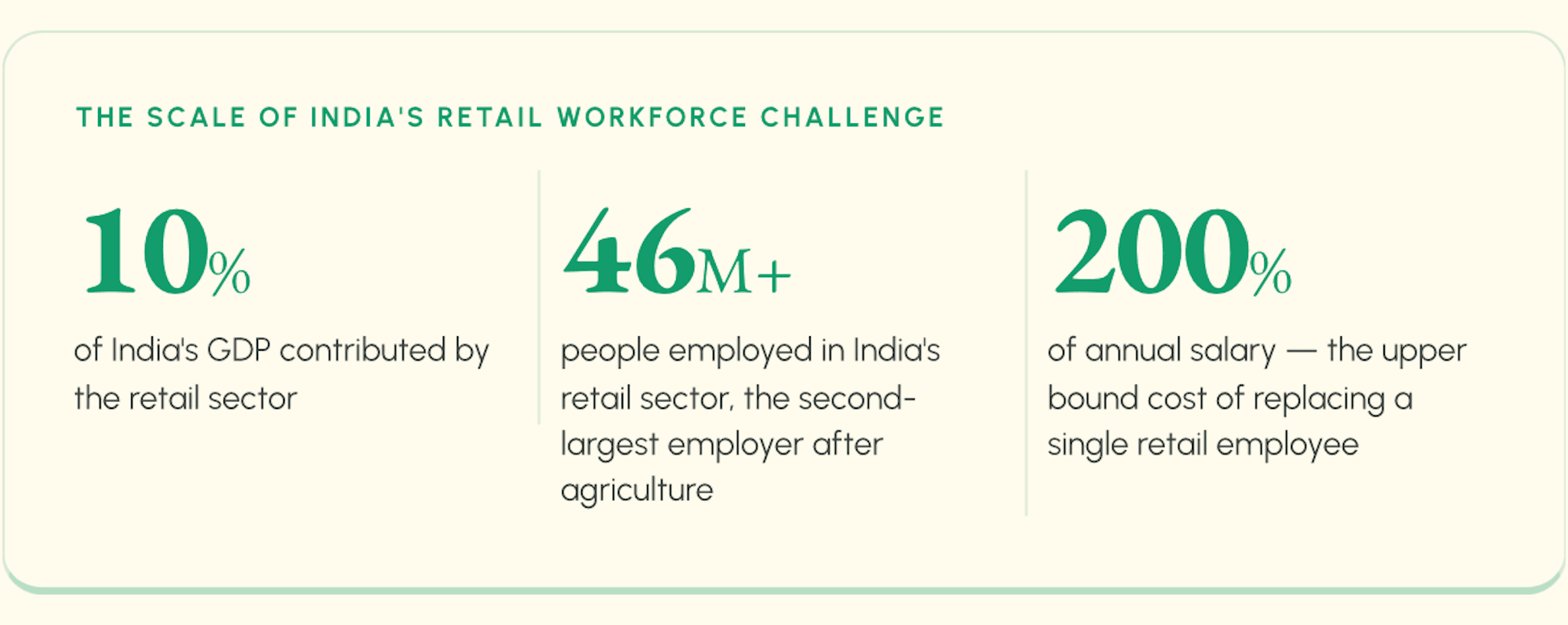
India’s retail sector is one of the country’s most powerful engines of economic growth. It contributes around 10% to the country’s GDP and is expected to reach a market size of USD 1.6 - 1.9 trillion by 2030, driven by rising consumption and rapid expansion across both organised and unorganised formats. As one of the fastest growing retail markets globally, expansion into Tier-2 and Tier-3 cities, alongside increasing competition and evolving consumer expectations, is reshaping how businesses scale and operate. For many organisations, retail represents both a high-growth opportunity and a critical channel for long term market presence, given its direct consumer reach.
Sustained performance in retail, however, depends not only on market demand or store expansion, but on the consistency of operations at the front end. Stores succeed or fail on everyday interactions between workers and customers. These interactions are shaped by the stability, capability, and experience of the workforce. These hidden costs, with replacing a retail employee estimated to cost anywhere from 16% to over 200% of their annual salary, limit the sector’s ability to scale efficiently even as revenues grow.
the operational challenge retailers know too well
Increasing attrition is a challenge the retail sector has been encountering for some time. Retailers routinely cycle through hiring, onboarding, and training new employees, only to repeat the process months later.
The consequences of this high turnover rate are borne by the bottomline. Frequent staff changes disrupt store performance, reduce productivity, and make it difficult to maintain consistent customer experience across locations. Managers spend valuable time recruiting and training rather than optimising operations. Institutional knowledge leaves with departing employees, along with investments in skill development.
In a sector defined by margins and scale, these hidden costs accumulate. As attrition becomes more widespread, it is often approached as an operational reality to manage rather than a problem to fundamentally solve.
why turnover persists
Understanding why turnover remains high requires looking beyond hiring pipelines to the realities of front end work. Retail roles often combine physical demands, emotional labour, and unpredictable schedules. Workers must handle customer interactions, manage peak traffic periods, meet sales targets, and adapt to evolving processes. Many front-end workers enter retail as their first formal job, often with limited exposure to structured training, professional norms, or customer facing environments. Communication challenges, unfamiliarity with professional norms, and limited exposure to customer-facing environments can make the transition difficult. At the same time, career pathways within retail are not always clearly defined, leading some employees to view these roles as temporary rather than long-term opportunities.
Supervisory dynamics also play a critical role. Managers shape day-to-day working conditions, influence morale, and determine how effectively teams function under pressure. However, supervisory roles are often filled based on operational experience rather than formal training in people management. When managers lack the tools to support and develop their teams, retention becomes significantly harder.
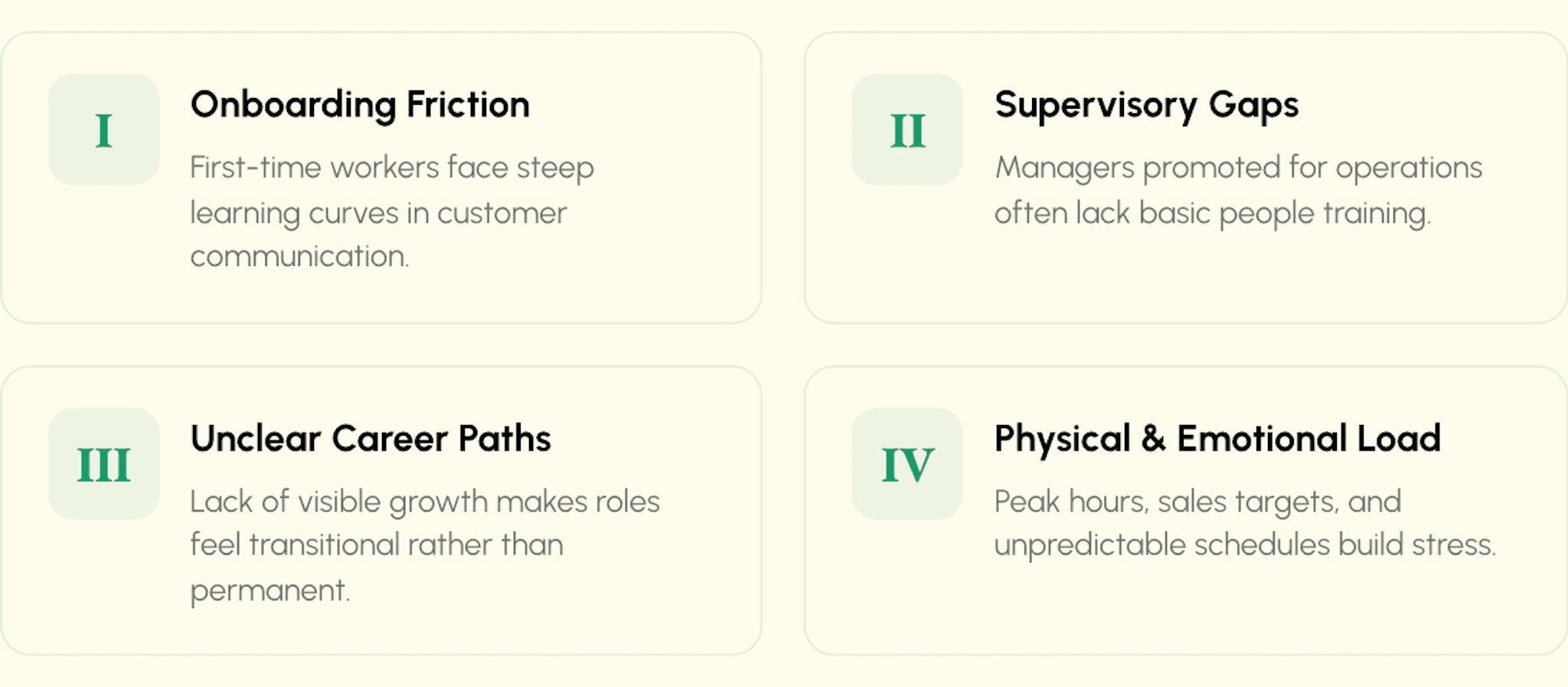
These factors do not reflect individual shortcomings. Rather, they point to structural features of how retail work is designed and supported. When these conditions remain unchanged, turnover becomes predictable, perhaps even rational.
why the challenge is intensifying
What has long been manageable may no longer be sustainable. As retailers expand into new geographies, they increasingly draw from labour pools with varying levels of experience in organised retail. At the same time, operations are becoming more complex. Digital inventory systems, automated checkout processes, omnichannel fulfilment, and data-driven performance metrics require new skills and adaptability from the staff.
Technology adoption in India’s retail sector is accelerating rapidly, with the market for retail automation and digital solutions expected to grow significantly in the coming years. Technology investments can enhance efficiency, but only if employees are equipped to use these systems effectively. Without adequate training and support, such investments may fail to deliver their full benefits, adding operational friction rather than reducing it.
Customer expectations are also rising. Today’s shoppers expect knowledgeable assistance, efficient service, and seamless experiences across physical and digital touchpoints. In an environment where online options are readily available, customers who choose to visit stores often expect a higher quality of service and continuity in their interactions, Physical retail spaces therefore play an important role in shaping customer relationships with the brand, Delivering this consistently requires stable teams who understand products, processes, and local customer preferences.
Taken together, these trends suggest that workforce stability is becoming increasingly central to retail performance. High turnover not only disrupts current operations but also constrains the sector’s ability to adapt to future demands.
moving beyond “normal” attrition
Given these conditions, what might a more stable workforce model look like in practice? Emerging practices across labour-intensive sectors suggest that targeted investments in people can yield meaningful operational benefits.
One area of focus is strengthening front end supervision. Managers trained in communication, conflict resolution, and team development are better positioned to support employees and create constructive working environments. Because supervisors directly influence daily experiences, improvements at this level can have disproportionate effects on morale and retention.
Practical workforce development is equally important. Training that aligns closely with real job demands, including customer interaction, problem-solving, and digital tools, helps employees become effective more quickly and reduces frustration on both sides. Ongoing skill development can also make roles feel more sustainable and valuable over time.
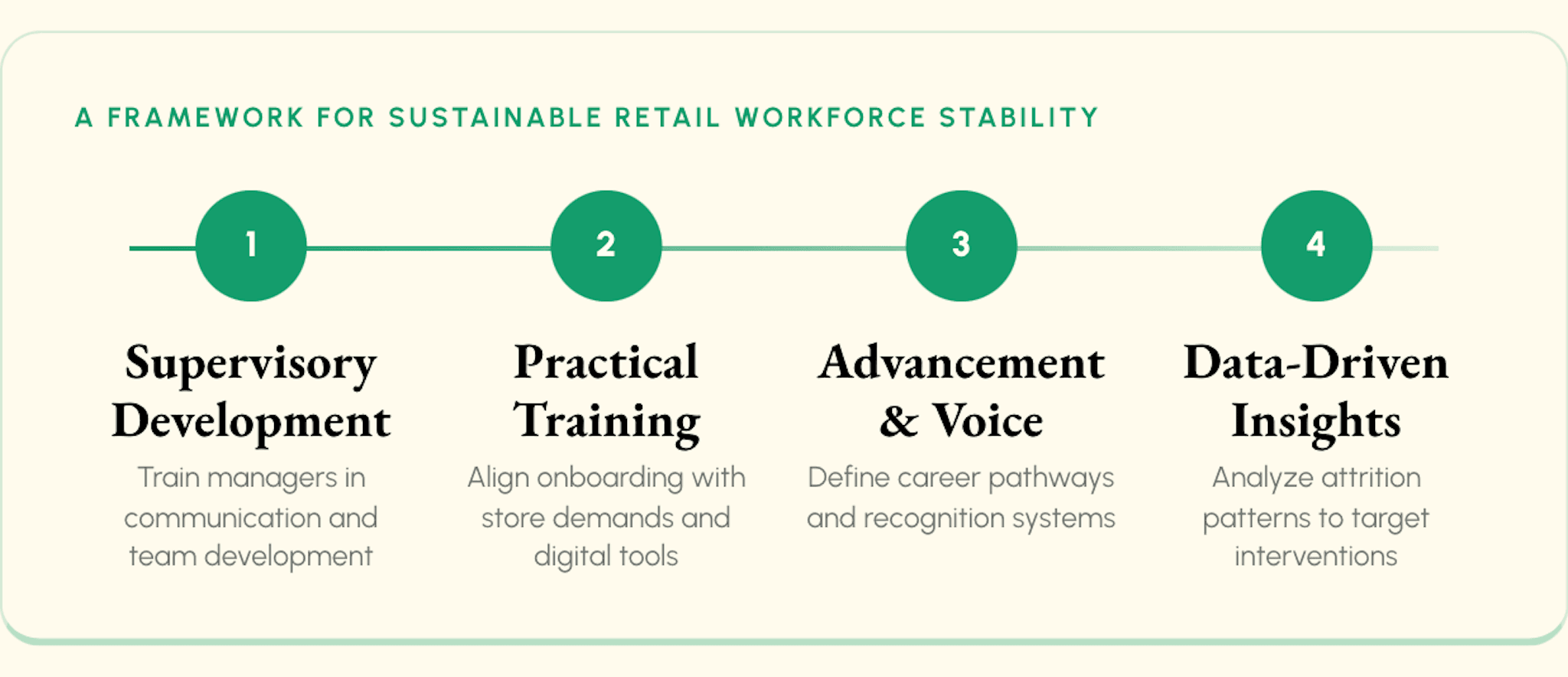
Retention is further shaped by workplace practices. Recognition of performance, opportunities for advancement, and mechanisms for addressing concerns all signal that employees are valued contributors rather than interchangeable staff. Even modest improvements in these areas can influence whether workers choose to stay or leave.
Increasingly, organisations are also using data to understand patterns of attrition. Analysing when employees leave, from which roles, and under what conditions can reveal actionable insights that intuition alone may miss. Such evidence-based approaches allow companies to target interventions where they will have the greatest impact.
Even incremental gains in retention can translate into significant savings in recruitment and training expenditure, while enabling more consistent service delivery and operational stability.
signals of change in the sector
Industry bodies and leading organisations are increasingly recognising that workforce instability is not merely an internal HR concern but a sector-wide constraint on growth. Collaborative initiatives are emerging to develop longer-term approaches to improving working conditions, skills, and retention across retail environments. Some efforts aim to produce playbooks or frameworks that organisations can adapt to their own contexts, reflecting a growing appetite for solutions that go beyond short-term fixes.
These initiatives remain in early stages, but they signal a shift in thinking, from accepting high attrition as inevitable to exploring how the sector might operate more sustainably.
a strategic opportunity for retail leaders
For retailers, improving workforce stability is not solely a social objective but a business opportunity. Lower turnover reduces recruitment and training costs, preserves institutional knowledge, and supports more consistent service delivery and performance. In a competitive, margin sensitive sector, these gains can become meaningful differentiators.
India’s retail sector has demonstrated remarkable resilience and adaptability over the past decade. The next phase of growth may depend less on expanding physical footprints and more on strengthening the human foundations that sustain daily operations. As expansion continues, organisations that can build stable, capable front end teams may gain a decisive operational advantage.
High attrition may be common, but it does not have to define the future of the sector.
related content
blog

why do happy employees in India's retail sector still leave?
Team GBL
9 mins
blog

why high turnover persists in retail — and why it matters now
Team GBL
6 mins
blog

budget 2026–27 and the next frontier of financial security
Parridhi A
6 mins