all case studies
earned wage access
Facilitating early withdrawal of earned wages can transform household finances for blue collar workers.

impact
33%
reduction in informal borrowing
8%
gain in worker productivity
Listen in as we discuss financial challenges faced by women workers in low-income contexts.

Karnataka, India, Asia Pacific
how might we improve household liquidity and stabilize household finances for millions of low-wage workers?
Low wage workers are often hit with unexpected expenses that drain finances before their next payday. This leads them to forgo essentials, rely on high-interest loans, and generally experience real psychological stress. By providing access to earned wages in advance of payday we found profound gains in financial security, reduced utilization of high-interest loans, and improved workplace retention.
scope
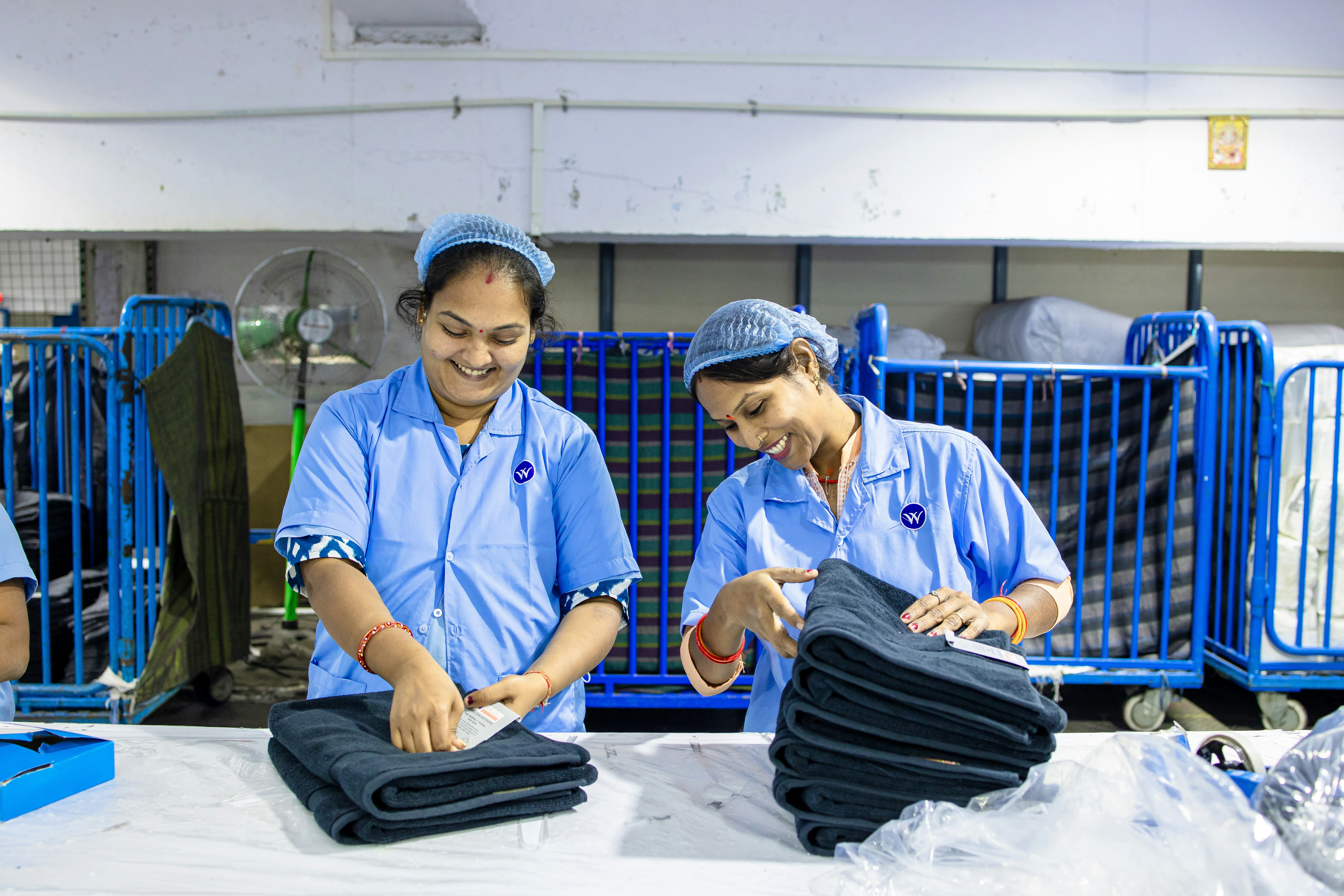
The average monthly wage for formally employed Indian garment workers is INR 14,000. While salaries across the manufacturing sector vary, similar financial pressures are experienced by millions of Indian blue collar workers. Evaluating approaches to ease these financial pressures have the potential to reduce debt, stabilize expenses, and crucially, reduce pressure felt by low-wage earners. Our study focused on 834 women garment workers in Karnataka, India.
approach
We wanted to ensure our study was well-grounded in the lived experience of our target population. Accordingly, we conducted extensive design research, combining interviews, focus group discussions, and observations. We also assessed commercially available EWA solutions to assess the possibility of piloting an existing technology solution. However, we soon discovered that despite the proliferation of app-based EWA tools, the very real barriers kept low-wage women workers from utilizing them effectively. As a result, we developed a simple, Android-based application for tablets installed within the workplace. This tool allowed workers to withdraw their earned wages via a direct transfer to their bank account in just a few taps.
Our tool allows workers to access up to 50% of their earned salary when they need it most. Watch this video to know how a flexible, employer-supported, interest-free tool can have far-reaching implications for women workers’ financial security and wellbeing while also improving business performance.
methodology
In order to uncover causal relationships between our EWA intervention and a range of worker and business metrics, we conducted a randomized controlled trial with the following design:
408 women workers in the treatment group
426 women workers in the control group
Baseline, mid-line, and end-line surveys to assess the state of household finances
Analysis of worker-level administrative data, including tenure, daily attendance, wages, and output
Analysis of EWA tool utilization, including per-worker transaction frequency and size
outcomes
Workers who had access to earned wages before payday demonstrated large gains in wellbeing:
33% reduction in informal borrowing
8% gain in worker productivity
21%
reduction in worker turnover
20%
less likely to forgo essential expenses
32%
less likely to report finding it difficult to make it from one paycheck to the next
potential
EWA tools have proliferated within the past 5 years, largely driven by both the appeal of improved liquidity for workers and market potential for financial services to earn substantial profits from micro-fees per transaction. In the absence of our study the precise impacts on workers and business has been difficult to quantify.
Our findings enable the development of a business case showing precisely how, and how access to earned wages can actually improve worker well being and workforce productivity. In focusing on the lowest wage earners, who are often ignored as less valuable by commercial solutions, our findings suggest a strong case for employers to subsidize earned wage access tools.