

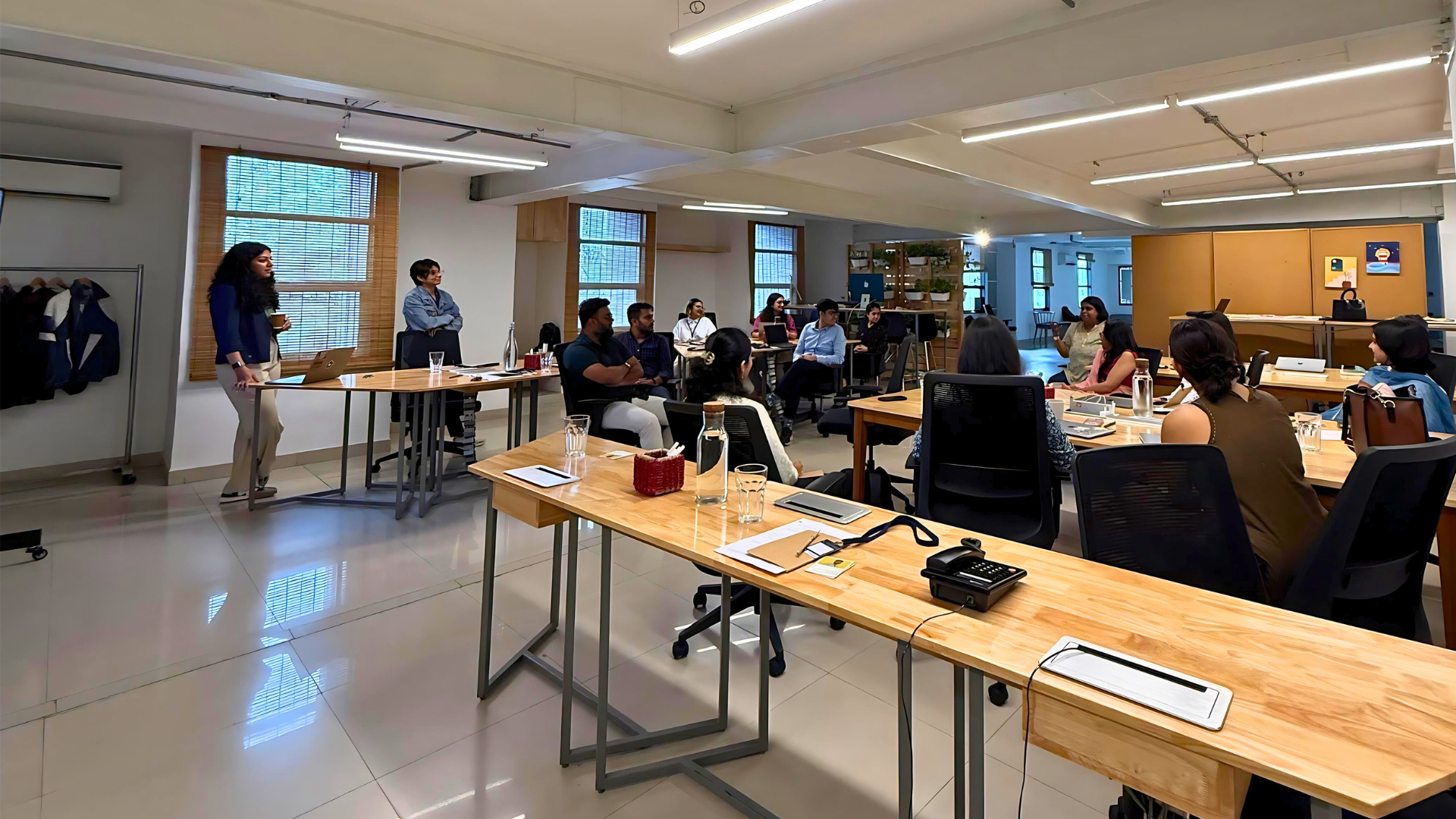

On July 31, 2025, Good Business Lab hosted its first-ever Unconference on the Platform Economy at our Delhi office. The format was semi-structured and participant-driven, bringing together representatives from platforms, NGOs, funders, and researchers for open discussion under the Chatham House Rule.
We focused on three thematic areas where evidence suggests the greatest potential for both worker welfare and business gains: climate adaptation, gendered mobility, and financial inclusion. The goal was to hold space for decision-makers to reflect, ask questions, and co-create ideas for solutions.
Discussions surfaced pressing questions: Is flexibility in gig work an illusion? Is the care infrastructure enough to support women who want to do the work? Who should take accountability? How do we ensure algorithmic transparency? The issue of gendered access was persistent throughout, with participants calling for ideas like a centralized gender data hub, context-specific impact metrics, and stronger engagement from multiple stakeholders.
Emerging Themes
Redesigning Flexibility That Works
Gig work is marketed as “flexible,” but its value differs for workers versus platforms. For women, flexibility is constrained by caregiving duties, transport availability, and safety concerns. “Flexibility has value only when paired with predictability, safety, and structural support.”
Inclusive Design as a Business Imperative
Workers’ lived experiences, especially those of women, remain underrepresented in both platform and public datasets. Inclusion isn’t just about recruitment — it means redesigning workflows, app features, and job categories to reflect diverse realities. Accessibility features, participatory design, and data collaboratives were highlighted as key opportunities.
Investing in Care Infrastructure
Care is not a perk, it is the foundation for participation. Lack of childcare, restrooms, and safe break spaces directly limits women’s participation. Promising models like Tamil Nadu’s rest stations show how co-located, gender-sensitive infrastructure can unlock access.
Making Algorithms Transparent
Opaque systems erode trust; transparency builds loyalty and retention. Participants raised questions about how current incentive systems may disadvantage certain workers and called for worker-centric dashboards, fairness audits, and co-designed performance metrics.
Aligning Public Policy and Platform Practice
Better coordination between ministries, platforms, and civil society is critical for scaling solutions. Data collaboratives, gender-responsive budgeting, and stronger convergence with national schemes were seen as pathways forward.
Download the detailed insights here. 👇
-
 budget 2026–27 makes the case for human capital
 -
 how better mobility unlocks women's access to work
 -
 good business forum 2025 - better work makes business better
 -
 mental health & migration: how fostering friendships between migrant workers improves mental health and productivity
 -
 the hidden cost of financial stress
