

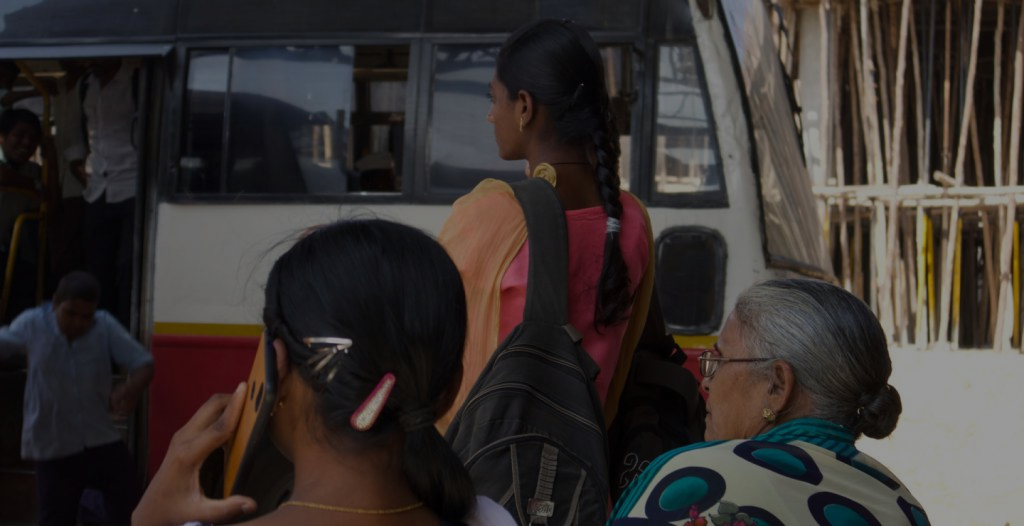

In urban India, many women from low-income communities remain out of the workforce, not only due to the restrictive social norms and lack of jobs but also because travelling to the workplace can often feel too far from their reach. A new study by GBL has found that the simple act of travelling with a peer to work makes women job seekers 85% more likely to participate in interviews. Something as simple as coordinating travel among women became a source of companionship, confidence, and agency.
The invisible barriers holding women back from seeking work
In India, the female labour force participation rate remains low at 33%, compared to 77% for men. Even as the availability of formal jobs across sectors grows, women continue to be significantly underrepresented in the Indian workforce. A key reason is that their ability to move freely and safely outside their home is still severely limited. For many of them, the decisions about stepping out for work are closely tied to household expectations and the approval of family members.
“I will think about it after consulting with my husband because he was upset yesterday when I mentioned that you wanted to come and talk”, shared one respondent.
This persistent barrier keeps even the women who want to work from actively seeking employment, which tells us that physical mobility proves to be one of the biggest yet one of the most overlooked barriers to women’s employment.
Together to work – an experiment in enabling opportunities
In 2024, GBL conducted a study in partnership with one of India’s largest garment exporters within five factories located in Faridabad and Noida, on the outskirts of New Delhi. At these factories, most workers are hired through walk-in interviews, yet in surveys of 700 prospective women workers, many said they wouldn’t feel comfortable commuting to the factory alone. Indeed, 70% of these women reported traveling with a companion whenever they ventured out for errands or socialization. But commuting with a companion wasn’t as feasible on a daily basis, given that it required having a companion headed in the same direction every day at the same time.
Our study considered the question of how facilitating a travel partner for work might unlock participation in paid work outside the home. Specifically, we invited 693 women from 106 low-income neighborhoods to interview for a real job and measured the impact of facilitated transportation.
1. Prospective workers were introduced to other workers with similar interview windows with a WhatsApp group to facilitate travel plans.
2. A control group of prospective workers who received an invitation letter but no introductions or travel coordination support.
The results were striking. Women who were paired up and able to travel together to interviews were 85% more likely to show up than those who were simply invited to interview.
One woman recalled how even a simple coordination made the journey feel easier,
“Three women, including me, went together, and we decided how to go, what time to leave, and how to give the interview. We discussed all these things two days before.”
In a separate pilot with 139 women across 15 neighbourhoods, one group received a travel subsidy without any matching or coordination. There was a modest increase in attendance of only 12.8 percent, and women still traveled with a companion, proving that financial help alone does not solve the problem.
This makes it clear that safety and social acceptance matter more than affordability. Even if travel costs are covered, women’s decisions depend on whether they feel secure and supported. For that, solutions must be designed to address social and mobility barriers.
Rethinking access, hiring, and support beyond transport
The study has important implications for how we think about hiring and employment of women in labour-intensive industries. Providing free transport or subsidies alone doesn’t address the social and mobility constraints. For employers, this intervention demonstrates how a low-cost solution can improve recruitment conversion as well as irregular attendance and high attrition rates of female employees. Even small changes in scheduling interviews, work shifts, and coordinating their travel can significantly increase the hiring and retention of women in the workforce.
The intervention shows that the real barriers to women’s employment often begin at their doorstep, even before they reach the workplace. Getting a job isn’t only about opportunities; it’s also about access and support. When these are in place, more women can take that first step and are more likely to keep going.
One respondent expressed while sharing her experience,
“This job experience taught me something new: Women should work, be self-dependent, and do something different. Household chores can still be managed while working outside.”
The solution isn’t complicated and the change doesn’t require large investments. It just needs people who listen, understand, and take small steps to help women travel to work safely.
Rethinking something as simple as the daily commute can unlock women’s participation in the workforce and reduce hiring and attrition challenges for employers.
If you’re seeking practical, low-cost ways to strengthen women’s participation in your company, let’s talk. Get in touch with us at info@goodbusinesslab.org.
About the Researchers:
Rolly Kapoor is a PhD candidate in Economics at the University of California, Santa Cruz. Her research explores how gender, access, and urban mobility shape women’s employment in developing countries.
Smit Gade is the Director of Data and Research at Good Business Lab.
References:
- Kapoor, Rolly and Gade, Smit, Together in Search: Experimental Evidence from Coordinating Travel Among Women Job-Seekers in Urban India (December 31, 2024). http://dx.doi.org/10.2139/ssrn.5113413
- Female labor force participation rate in India 2024
-
 budget 2026–27 makes the case for human capital
 -
 rethinking the platform economy: insights from GBL’s first Unconference
 -
 good business forum 2025 - better work makes business better
 -
 mental health & migration: how fostering friendships between migrant workers improves mental health and productivity
 -
 the hidden cost of financial stress
