
all case studies
soft skills for factory supervisors
Soft skills training can transform tense work environments, reducing turnover & increasing worker satisfaction.
project type

capability development
impact
5.8%
increase in productivity
15%
reduction in turnover
project partners
Options and Solutions, Shahi Exports, University of Michigan, University of Maryland

Karnataka, India, Asia Pacific
can soft skills training help factory supervisors create more harmonious and high-performing assembly lines?
Supervisors in manufacturing settings are most often promoted into these roles because of their technical expertise, despite having limited training in management or people skills. As a result, outdated management styles are the norm on factory floors, leading to hostile work environments. Our work piloting and evaluating a comprehensive soft skills training program for supervisors dramatically increased productivity, decreased turnover and resulted in higher pay for workers.
scope
On factory floors where production pressure is high and every minute counts, things often get tense. In garment factories where frontline workers are largely women and managers are almost all men, this situation is exacerbated by gender and power dynamics. As a result, abuse and harassment are common, and demotivated workers quit in high numbers, hurting their own income stability and impacting production targets for employers. In fact, annual turnover in the Indian manufacturing industry is almost 28%. Soft skills training has the potential to change the way supervisors manage their teams, resulting in happier workers who are more productive and less likely to resign.
approach
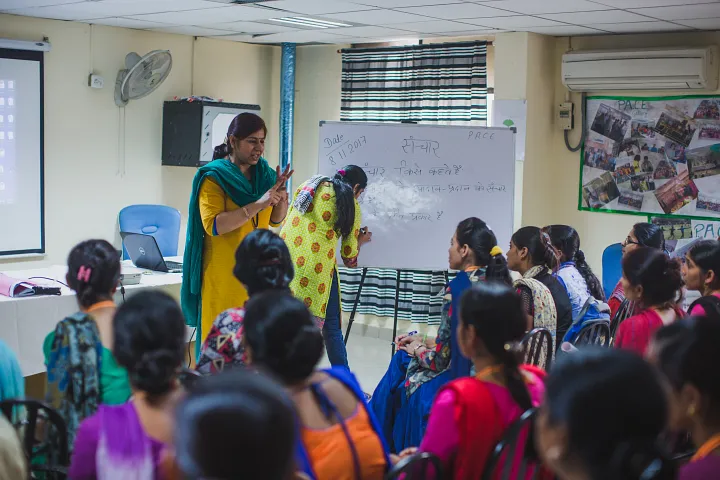
After conducting extensive research with supervisors in garment factories, we designed a soft skills training program called STITCH (Supervisors Transformation into Change Holders) in collaboration with Options & Solutions, a personnel consultancy firm. This program trains factory production line supervisors in five areas: emotional intelligence, collaboration, planning, conflict resolution and leadership. The training is available in-person and online, in multiple Indian languages.
We discovered that social conventions and learned behaviors influence supervisors’ management styles. Many believed they needed to shout at and instil fear in workers to ensure productivity. Our training was designed to challenge these norms and offer supervisors alternate managerial styles and approaches for more positive workplaces.
Discover how STITCH is transforming workplaces. Implemented in 60 factories with 70,000 workers, STITCH enhances communication, conflict resolution, and time management, leading to a decrease in turnover, and an increase in productivity and workers’ income.
methodology
In order to assess the causal impact of soft skills training for line supervisors on worker and production outcomes, we conducted a randomized controlled trial with the following design:
482 line supervisors in the treatment group
472 line supervisors in the control group
We focused on supervisors managing production lines, across a total of 561 lines.
Baseline, mid-line, and end-line data collection included information on supervisor demographics and training participation
Administrative factory data was used to track worker-level outcomes such as attrition, productivity, absenteeism, and promotions
This design allowed us to rigorously evaluate how investing in supervisor skills influences frontline team dynamics and overall production performance.
outcomes
15% decrease in turnover
5.8% increase in productivity
54x
return on money invested
35%
improvement in worker pay
potential
Our study shows that training factory supervisors in soft skills has tangible impacts for businesses and workers – increasing efficiency, reducing attrition and improving employee incomes. STITCH has the potential to break the cycles of abuse and harassment that are all too common on factory floors. Soft skills are some of the most transferable skills, paving the way for further professional growth among low income workers. These skills also improve self-esteem, gender sensitivity, problem-solving, planning and more.
In contexts where ‘hard’ technical skills are considered most desirable in supervisors, our study makes a business case for firms to invest in soft skills training.
explore our work



ready to improve worker wellbeing?
invest in workers, invest in progress.