improving women’s health and autonomy in India’s industrial workforce

-
 solution & design

Women across India continue to face significant gaps in sexual and reproductive health (SRH) knowledge, access, and agency. Many rely on inaccurate information, face stigma around menstruation and contraception, and have limited mobility to seek reliable care.
Our pilot tested whether a structured, workplace-delivered SRH program could meaningfully improve women’s understanding of sexual and reproductive health, shift attitudes rooted in stigma, and encourage healthier decisions in a supportive environment.
SRH gaps remain widespread even with decades of public health programming. Common challenges include:
- Poor menstrual hygiene management, especially among low-income or migrant women
- Limited knowledge of pregnancy, contraception, and safe abortion
- Low reproductive autonomy, with decisions often controlled by partners or family
- Under-recognition of harassment and violence due to stigma and silence
The pilot explored whether an accessible, factory-based SRH training model could:
- Build foundational SRH literacy
- Shift attitudes shaped by misinformation and cultural norms
- Strengthen confidence and awareness of rights
- Encourage healthier day-to-day behaviours
- Deliver these gains in a cost-effective, scalable way
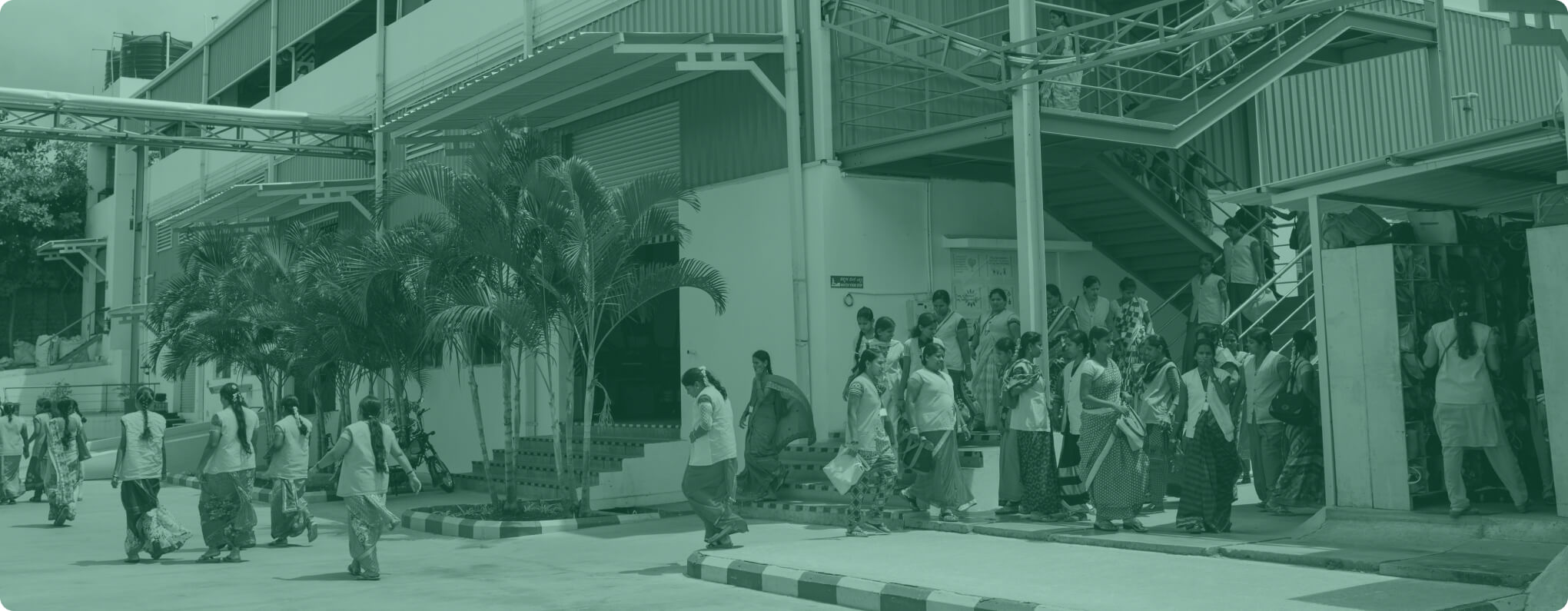
We worked with 117 migrant women workers in Bengaluru.
We partnered with Project Baala, an SRH expert organization, to design and test a comprehensive training curriculum tailored for low-income, migrant women workers.
The training covered six domains essential for women’s health and autonomy:
1. General Health
2. Reproductive System
3. Menstruation
4. Pregnancy
5. Contraception & Safe Abortion
6. Domestic Violence & Sexual Harassment
An experienced master trainer, equipped in this subject delivered the sessions within factory spaces redesigned into private and secure environment/space. To build comfort and trust, participants were divided into five small groups of 11–15 members each, encouraging peer interaction and open dialogue leading to meaningful discussions.
Sessions lasted 45–60 minutes, held weekly over 16 weeks. The design emphasized:
- Safe spaces enabling women to speak openly;
- Visual learning tools (videos, pictures) to simplify biological concepts;
- Gradual rapport-building over four months;
- Normalizing conversations around SRH through repeated, guided discussions.
The pilot was conducted in a garment factory in Bengaluru, engaging 117 migrant women workers.
Evaluation Design
The study employed a before after survey for both treatment and control groups, allowing us to measure changes attributable to the training.
The evaluation assessed impacts across three dimensions:
- SRH Knowledge
- SRH Attitudes
- SRH Behaviors
Data Collection
Surveys captured:
- knowledge of menstruation, pregnancy, contraception, STDs, and violence;
- attitudes toward menstrual stigma, contraceptive use, reproductive autonomy, and domestic violence;
- self-reported health practices and sexual/reproductive behaviors.
1. Knowledge Gains
Workers who received the training reported:
Participants described the sessions as transformative, especially understanding menstruation from a biological perspective.
A participant shared:
“I learned a lot from the trainer. I even shared a video on menstruation on our WhatsApp group and explained to my roommate how periods actually happen. She said she had never known this before.”
2. Attitude Shifts
Beyond knowledge, the training was associated with meaningful differences in attitudes between workers who received the training and those who did not.
Compared to the control group, trained workers showed:
- Stronger agreement on the need to seek medical care for irregular periods or abnormal discharge
- More supportive attitudes toward women’s reproductive autonomy and less acceptance of domestic violence
3. General Health Behaviours
Given the relatively small proportion of married and sexually active participants, findings related to sexual and reproductive behaviours are interpreted as directional rather than conclusive.
Clear differences emerged between trained and untrained workers:
- Among sexually active participants, 70% of trained workers reported refusing unwanted sex, compared to 57.1% in the control group
- Contraceptive use was higher among trained workers (40%) than among those who did not receive the training (28.6%)
Importantly, trained workers also reported higher recognition of sexual harassment, particularly in public spaces.
Workplace-delivered SRH programs offer a promising, scalable model for improving women’s health and autonomy in India’s industrial workforce. They provide consistent access to women who might otherwise be difficult to reach and create structured environments where women already gather daily, overcoming mobility restrictions. The cost per worker can remain low due to the high concentration of workers, making the model feasible for large employers.
With low per-worker costs at scale and strong evidence of meaningful attitude and knowledge shifts, the pilot provides a blueprint for system-wide, workplace-integrated SRH initiatives that can advance gender equity and worker wellbeing across India. This intervention supplemented with a service provision intervention (for example providing access to free healthcare or menstrual products) can improve behaviour in the short run.
Beyond factories, the approach can be adapted for home-based workers, construction workers, agricultural workers, and women in informal urban employment.
Evidence from multiple studies shows that workplace SRH interventions benefit both workers and employers. Programs that pair information with access to menstrual products improve attendance and reduce absenteeism. Evaluations of the HERproject – a global workplace program that delivers women’s health and financial literacy training in supply chains, also report business gains, including lower absenteeism and turnover, better use of existing health facilities, improved worker satisfaction, and productivity improvements, alongside broader workforce development benefits (Czura et al., 2019; Yeager & Goldenberg, 2011; Hossain et al., 2017).
While business gains are important, they are one part of the value of workplace SRH programs. Interventions that improve worker wellbeing, dignity, and informed decision-making have intrinsic importance. They equip women with the knowledge and confidence to make their own health choices, seek timely care, and navigate stigma. Over time, this strengthens women’s ability to participate in household decisions, remain engaged in work, and build greater economic security. These factors align with the core elements of good jobs by supporting workers’ health, livelihood, and autonomy.